
Why the Brain of Future Machine Tools Lives in the Cloud, Not in the Cabinet
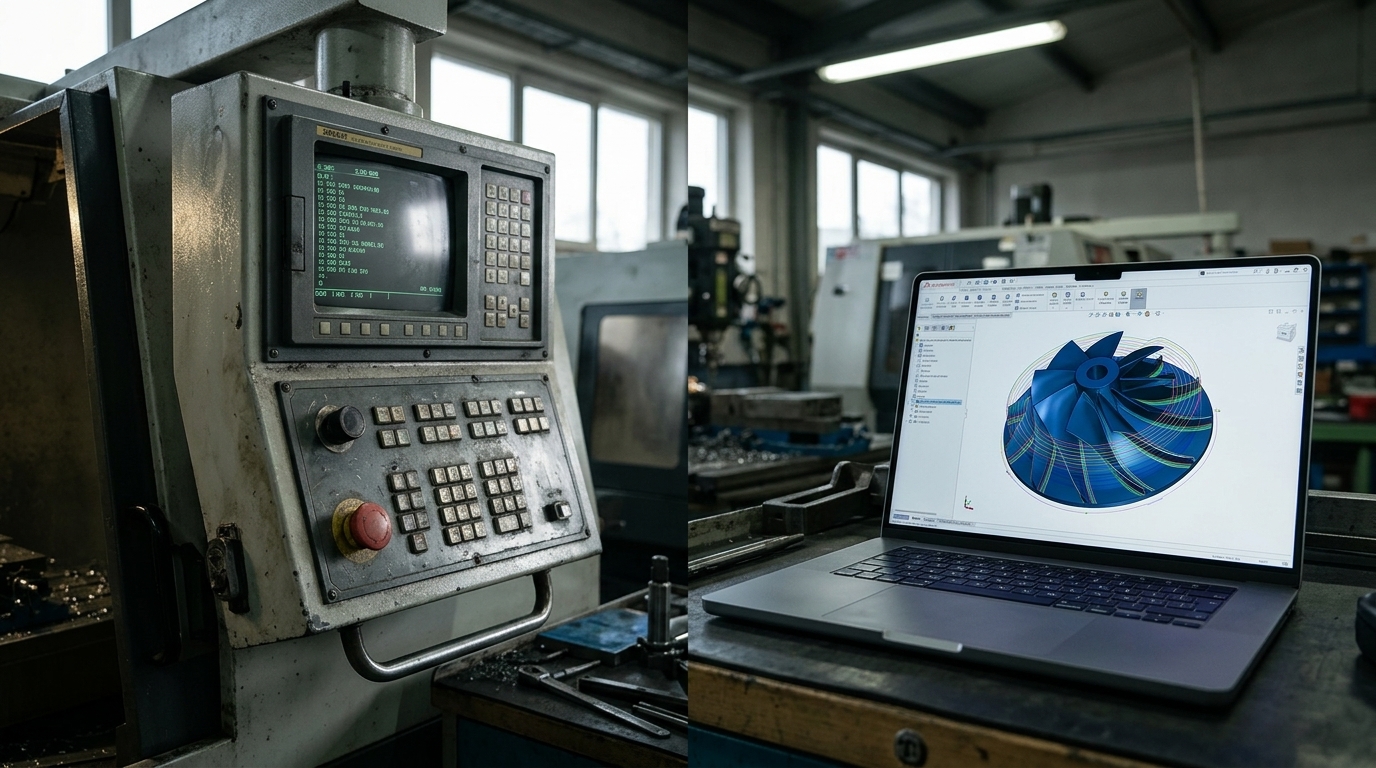
Open the electrical cabinet of a modern, multi-axis CNC machine tool, and you will find an ironic truth. Surrounding the pristine cast iron, chilled spindle, and sub-micron linear scales sits a controller running on hardware that would struggle to power a smartphone from 2012.
Whether it is a yellow Fanuc box, a Siemens Sinumerik unit, or a Syntec board, industrial controllers are marvels of deterministic engineering. They execute servo loops every millisecond with zero jitter. They can interpolate G-code reliably for decades without a blue screen.
However, they were never designed to think.
As manufacturing races toward autonomous multi-axis toolpaths, dynamic chip-load balancing, and physics-level collision simulation, the industry has hit an architectural wall. Trying to run modern spatial neural networks and full kinematic digital twins inside a machine’s electrical cabinet is a physical dead end. The future of CNC manufacturing relies on a fundamental architectural shift: the muscle stays on the shop floor, but the brain moves to the cloud.
1. The Bottleneck Inside the Cabinet
Why haven't machine tool controllers evolved like consumer computers?
Because industrial hardware operates under strict real-time safety certifications. A controller cannot freeze, drop a packet, or hesitate for a fraction of a millisecond while calculating a tool vector—otherwise, a $15,000 spindle plows into a $40,000 casting.
Because reliability is paramount, machine controllers use hardened, low-frequency silicon with minimal RAM. They are built to read pre-calculated linear movements: Move from Point A to Point B at Feedrate F.
The Legacy Trap:
Pre-calculated G-code ➔ Controller Buffering ➔ Servo Amplifiers ➔ Linear Motion
(Zero spatial awareness. Zero understanding of uncut stock geometry.)
This hardware architecture was fine when machine tools cut 2D contours or indexed 3-axis prismatic blocks. But modern 5-axis machining demands massive geometric computation:
- Continuous 3D stock-volume tracking.
- Dynamic engagement-angle calculation to protect carbide tools.
- Global vector collision avoidance between the part, stock, jaws, toolholder, and trunnion table.
Expecting an electrical cabinet to execute these calculations in real time is a category error. It’s like expecting the ECU of a car’s fuel injector to also calculate autonomous driving navigation.
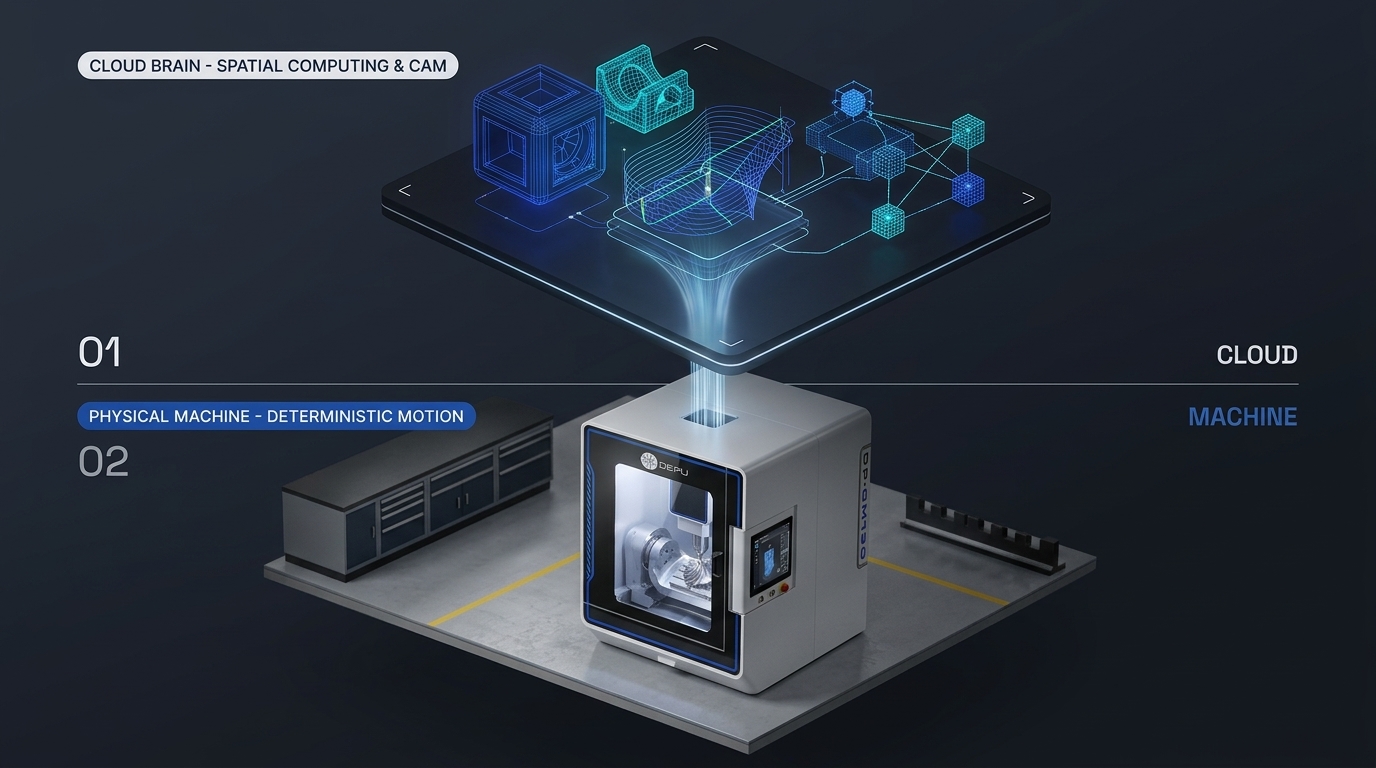
2. Decoupling the "Muscle" from the "Mind"
Machine tools have two distinct jobs: calculation and actuation.
The hardware on the shop floor—the machine bed, direct-drive motors, high-torque spindle, and coolant circuits—represents the muscle. Mechanical physics does not change quickly. Good cast iron from thirty years ago is still good cast iron today.
The software—the toolpath logic, spatial clearance checking, and cutting strategies—represents the mind. Unlike mechanical iron, spatial AI and geometric algorithms evolve every single week.
┌────────────────────────────────────────────────────────┐
│               THE CLOUD BRAIN (Chuix AI)                │
│  • Complex Surface Feature Recognition                 │
│  • Automated 5-Axis Toolpath Generation                │
│  • 100% Collision-Free Digital Twin Simulation         │
└───────────────────────────┬────────────────────────────┘
                            │ (Verified, Collision-Free Code)
                            ▼
┌────────────────────────────────────────────────────────┐
│             THE ON-MACHINE MUSCLE (The Iron)           │
│  • Microsecond Deterministic Motion                    │
│  • Closed-Loop Servo Actuation                         │
│  • True Metal Removal & Rigid Cutting                  │
└────────────────────────────────────────────────────────┘
When you attempt to put the "mind" inside the machine (or on dedicated, dust-choked PCs parked next to individual machine enclosures), you create an IT maintenance nightmare:
- Compute Throttling: Complex 5-axis paths take hours to calculate locally or force programmers to use coarse tolerances to speed up calculations.
- Hardware Obsolescence: The machine outlives its onboard computing hardware within 5 years.
- Data Silos: Machining parameters, crash data, and tool-life insights remain trapped on a single machine's hard drive
3. What Actually Happens When CAM Lives in the Cloud?
Moving toolpath planning and simulation off the local workstation into Cloud-based CAM changes what is technically possible on the factory floor.
A. Infinite Compute for 3D Geometry
When you drop a complex STEP file into a browser-based platform, you aren’t limited by the CPU cores on a local desktop. Cloud clusters spin up dozens of compute nodes in parallel to analyze complex draft angles, undercut cavities, and swept surfaces simultaneously. What used to take an operator 45 minutes of clicking through nested CAM menus happens autonomously in seconds.
B. True Voxel-Level Digital Twin CNC Simulation
Most machinists don't trust CAM simulations because local software takes shortcuts. To avoid freezing your PC, traditional CAM approximates toolholder clearance using simplified bounding boxes or low-res meshes.
Cloud-native simulation does not compromise on resolution:
- It simulates the exact volumetric stock removal at every micro-step.
- It checks the true CAD geometry of the cutting tool, shank, collet nut, spindle nose, and clamps.
- If a potential gouge or axis-overtravel exists, the cloud engine detects it mathematically and recalculates the tool vector before a single block of G-code is written.
C. A Brain That Updates Daily Without Service Calls
When an industrial machine tool controller ships from the factory, its software is essentially frozen in time. Upgrading an on-machine control system often costs thousands of dollars and requires a field technician with proprietary cables. A cloud brain operates like modern web infrastructure: cutting physics algorithms improve continuously, and new tool geometry profiles update globally without downtime or dongles.
4. Chuix AI: A Cloud Brain for Every Machine Tool, Whoever Built It
At Chuix, our approach to manufacturing software is simple: We believe machine tools should cut with absolute certainty, regardless of who manufactured the iron.
The bottleneck in modern precision manufacturing is no longer the rigidity of the ball screws or the RPM of the spindle. The bottleneck is the fragile, manual human pipeline connecting a 3D CAD design to the machine's axis coordinates: finding lead-in angles, manually setting safe retract planes, and staring through a coolant-splattered window with a finger hovering over the emergency stop.
The Chuix App bridges this gap by turning cloud-native AI into an active co-pilot for machine tools:
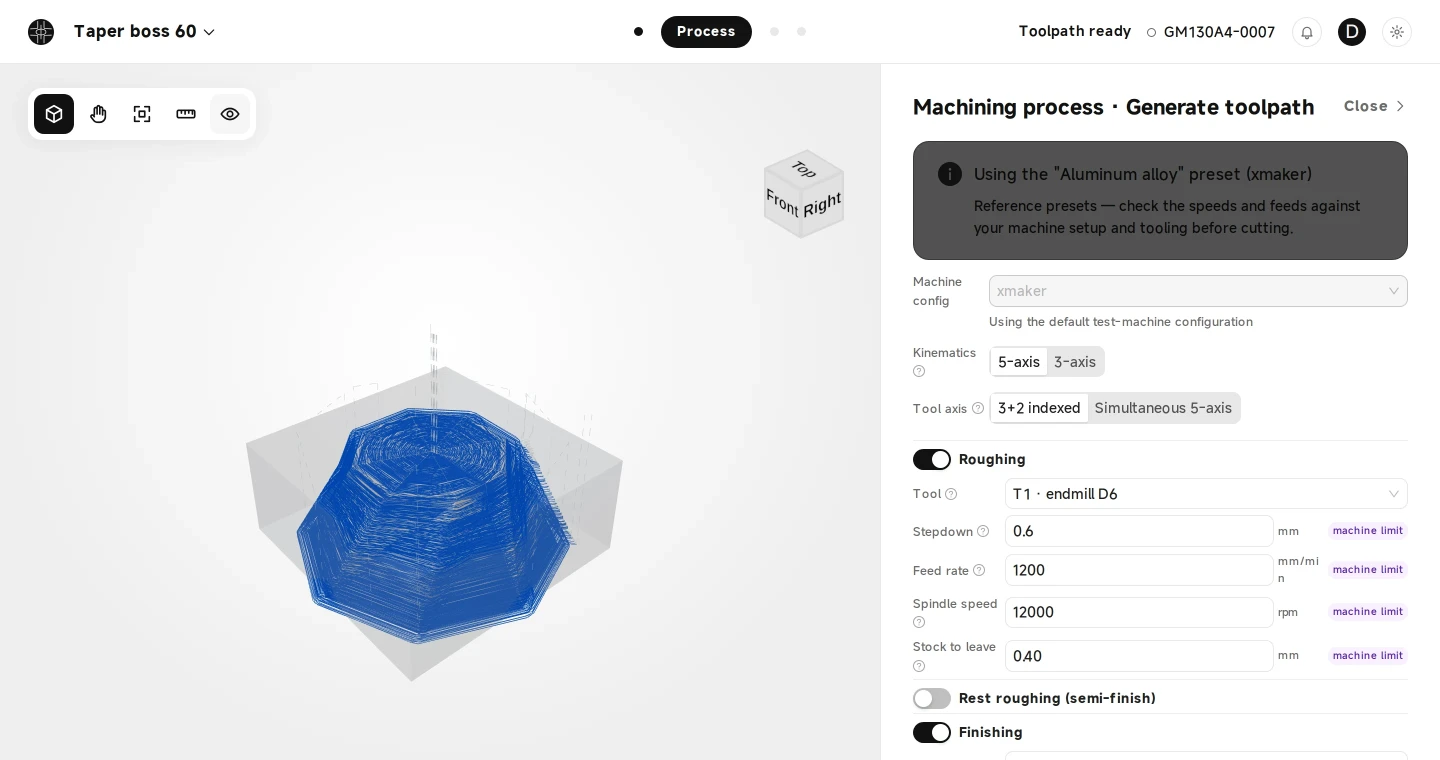
- Import the CAD model directly into your browser.
- Let the cloud brain evaluate the volume, choose the optimal tool sequence, and generate collision-free multi-axis toolpaths.
- Simulate with zero shortcuts, verifying clearances in a full digital twin.
- Send verified code to the machine and press start with complete peace of mind.
The Verdict: Don’t Upgrade the Cabinet. Upgrade the Connection.
For fifty years, machine tool builders tried to make CNC machines smarter by stuffing larger computers into their electrical cabinets. It is time to accept that the physical enclosure was the wrong place for the brain all along.
The physical machine tool is a master of rigidity, precision, and raw force. Keep it doing what it does best. By connecting that iron to a dedicated cloud brain, we eliminate the operational fear of 5-axis programming, bypass the skilled-labor bottleneck, and enter a new era of smart manufacturing AI where every single cut is executed with certainty.
Experience Autonomous 5-Axis Machining in Your Browser
Curious how a cloud brain transforms your daily machining workflow?
Launch the Chuix App directly in your browser, or
schedule a demo with our engineering team to see autonomous multi-axis toolpath generation on your own CAD files.